

Switching Accountants as an IT Contractor: How It Works
Switching accountants as an IT contractor is simpler than you think. Learn the warning signs, how professional clearance works, and what happens to your records.

16 November 2026 · 9 min read
- 3 stepsAll you need to do yourself
- < 1 hourOf your time for the whole switch
- 2–4 weeksFor most handovers between firms
Your accountant takes two weeks to reply to a simple email, has never mentioned IR35, and you are not entirely sure they understand how contractor limited companies work. If that sounds familiar, you are already overdue a conversation about switching accountants. The good news is that the process is far simpler than most contractors expect, and the disruption to your day-to-day is minimal.
This article walks you through exactly when it makes sense to switch, what the professional handover process looks like, and how little you actually have to do to make it happen. Specifically, you will learn the warning signs that your current accountant is not right for IT contracting, exactly how professional clearance works between firms, and what happens to your FreeAgent access and historical records so you can switch with complete confidence.
If you are already looking for a better fit, our affordable monthly accounting packages for contractors are a good place to start.
Signs your current accountant is not right for IT contracting
Not every accountant is built for contractor work. A general practice that handles local shops and sole traders may technically be able to file your corporation tax return, but that is a long way from understanding the nuances of IR35, dividend planning, or the confirmation statement obligations that come with running a limited company.
Here are the clearest warning signs that your current firm is not the right fit:
- They have never raised IR35 with you. IR35 is one of the most significant tax risks for IT contractors operating through a limited company. If your accountant has not discussed it, they are either unaware or not engaged enough to flag it proactively.
- Response times are consistently slow. Contractors work to tight project timelines. Waiting a week or more for a reply to a basic question about expenses or payroll is not acceptable when you are running a business.
- They do not use cloud software. If your accountant is still working from spreadsheets or emailing PDFs back and forth, they are not set up for Making Tax Digital compliance, which is now a live requirement for many businesses and expanding further.
- You feel like a small fish. Some firms take on contractor clients but prioritise larger commercial accounts. If you rarely hear from them unless you chase, that is a structural problem, not a temporary one.
- They cannot advise on salary and dividend planning. This is core to running a limited company tax-efficiently. If your accountant has never discussed the optimal split between salary and dividends, you are likely paying more tax than you need to.
Christian, one of our clients at Focus Accountancy, put it well: "Helpful, knowledgeable team that make time to provide jargon-free planning and advice." That is the baseline you should expect, not a bonus.
How the switch actually works: professional clearance explained
What is professional clearance when changing accountants?
Professional clearance is the formal process by which your new accountant contacts your old one to request your financial records and confirm there are no outstanding issues. It is a standard part of the handover between accountancy firms and is governed by professional ethics rules set by bodies including ICAEW and ACCA.
In practice, your new accountant sends a professional clearance letter to your outgoing firm. This letter asks for confirmation that there is nothing that would prevent them from acting for you, and requests the transfer of relevant documents including prior year accounts, tax returns, and any correspondence with HMRC. You do not write this letter. Your new accountant handles it entirely.
The outgoing firm is professionally obligated to respond promptly and honestly. They cannot withhold your records out of frustration that you are leaving, and they cannot charge you for releasing them. Your financial records belong to you.
Who contacts whom, and what happens if your old accountant goes quiet
The sequence is simple. You notify your current accountant in writing that you are leaving and name your new firm. Your new accountant then sends the professional clearance letter directly to the outgoing firm. You do not need to be the go-between.
Most handovers complete within two to four weeks. Occasionally, an outgoing firm is slow to respond. If that happens, your new accountant can follow up directly. If the delay is significant and a filing deadline is approaching, your new accountant can work from the information you already hold, such as prior year accounts, bank statements, and any correspondence from HMRC, while the formal clearance is still in progress.
If your old accountant is genuinely unresponsive, your new firm can escalate through the relevant professional body. This is rare, but it is an option.
What happens to your FreeAgent access and historical records
What happens to my FreeAgent account if I change accountants?
This is one of the most common practical concerns for contractors already using cloud software, and it is one that most switching guides completely ignore. Here is what actually happens.
FreeAgent accounts are owned by the client, not the accountant. If your current accountant set up your FreeAgent subscription as part of their package, the account may be linked to their practice. When you switch, your new accountant can either transfer that account to their own FreeAgent practice or set up a fresh account and migrate your data. Either way, your historical transactions, invoices, and records are not lost.
At Focus Accountancy, every client package includes a FreeAgent subscription as standard. If you are switching to us, we handle the transition of your FreeAgent access as part of the onboarding process. You do not need to export spreadsheets or manually recreate anything. For more on what a FreeAgent accountant does and why it matters for contractors, we have covered this in detail separately.
Beyond FreeAgent, your new accountant will need copies of your last two years of company accounts, your most recent corporation tax return, any active PAYE or VAT registrations, and your Companies House details. Most of this comes via the professional clearance process. The rest you can usually pull from your HMRC online account or your existing FreeAgent records.
When is the best time to switch? Timing around year-end and deadlines
Can I switch accountants mid-year?
Yes, and it is often the right call even if it is not a tidy year-end. Waiting until your company year-end to switch is a common instinct, but it is not always necessary. The more important consideration is avoiding a switch in the weeks immediately before a major filing deadline.
For limited companies, the key dates to be aware of are the corporation tax payment deadline (nine months and one day after your accounting year-end), the corporation tax return deadline (12 months after year-end), the company accounts filing deadline at Companies House (nine months after year-end), and your VAT return due dates if you are VAT registered. Switching two to three months before any of these gives your new accountant enough time to get up to speed without rushing.
Timing
Key deadlines after your company’s year-end
- 9 monthsAccounts to Companies House
- 9 months + 1 dayCorporation tax payment
- 12 monthsCorporation tax return
Switch two to three months before a deadline and your new accountant has time to get up to speed.
If you are mid-year and none of these deadlines are imminent, switching now is perfectly sensible. Your new accountant picks up from wherever your records currently sit. There is no requirement to wait. For a fuller picture of corporation tax deadlines for limited companies, it is worth understanding the full filing calendar before you time your move.
The one scenario where timing genuinely matters is if your old accountant is mid-way through preparing your accounts. In that case, it is cleaner to let them complete the work and then switch, rather than asking a new firm to pick up a half-finished set of accounts.
How to check your new accountant is qualified and regulated
This step is skipped by most contractors, and it is a mistake. Not everyone who calls themselves an accountant is regulated. In the UK, the main professional bodies for qualified accountants are ICAEW, ACCA, and AAT. A regulated firm must follow professional ethics rules, carry professional indemnity insurance, and is subject to oversight and disciplinary procedures.
Before you sign up with any new firm, ask directly which professional body they are regulated by and check the public register on that body's website. For IT contractors specifically, also ask whether the firm has experience with IR35 assessments, limited company dividend planning, and Making Tax Digital compliance. These are not niche questions. They are the basics of contractor accountancy.
Focus Accountancy works with contractors, consultants, and freelancers across engineering, IT, software development, and professional services. We are rated in the top 1% of thousands of UK accountants, and every client gets unlimited phone and email support as standard, not just during onboarding.
What you actually have to do (it is less than you think)
How do I switch accountants for my limited company?
Here is the honest summary of what switching actually requires from you as a contractor:
- Choose your new accountant and confirm they are regulated and experienced with limited company contractor work.
- Notify your current accountant in writing that you are terminating the engagement. A short email is sufficient. You do not need to give a reason.
- Sign a letter of engagement with your new accountant and authorise them with HMRC (usually online, or on form 64-8 where an online route isn't available), which allows your new accountant to communicate with HMRC on your behalf.
- Let your new accountant handle the rest. They send the professional clearance letter, chase the handover documents, and set up your FreeAgent access.
The switch
Switching accountants: what you do, and what we do
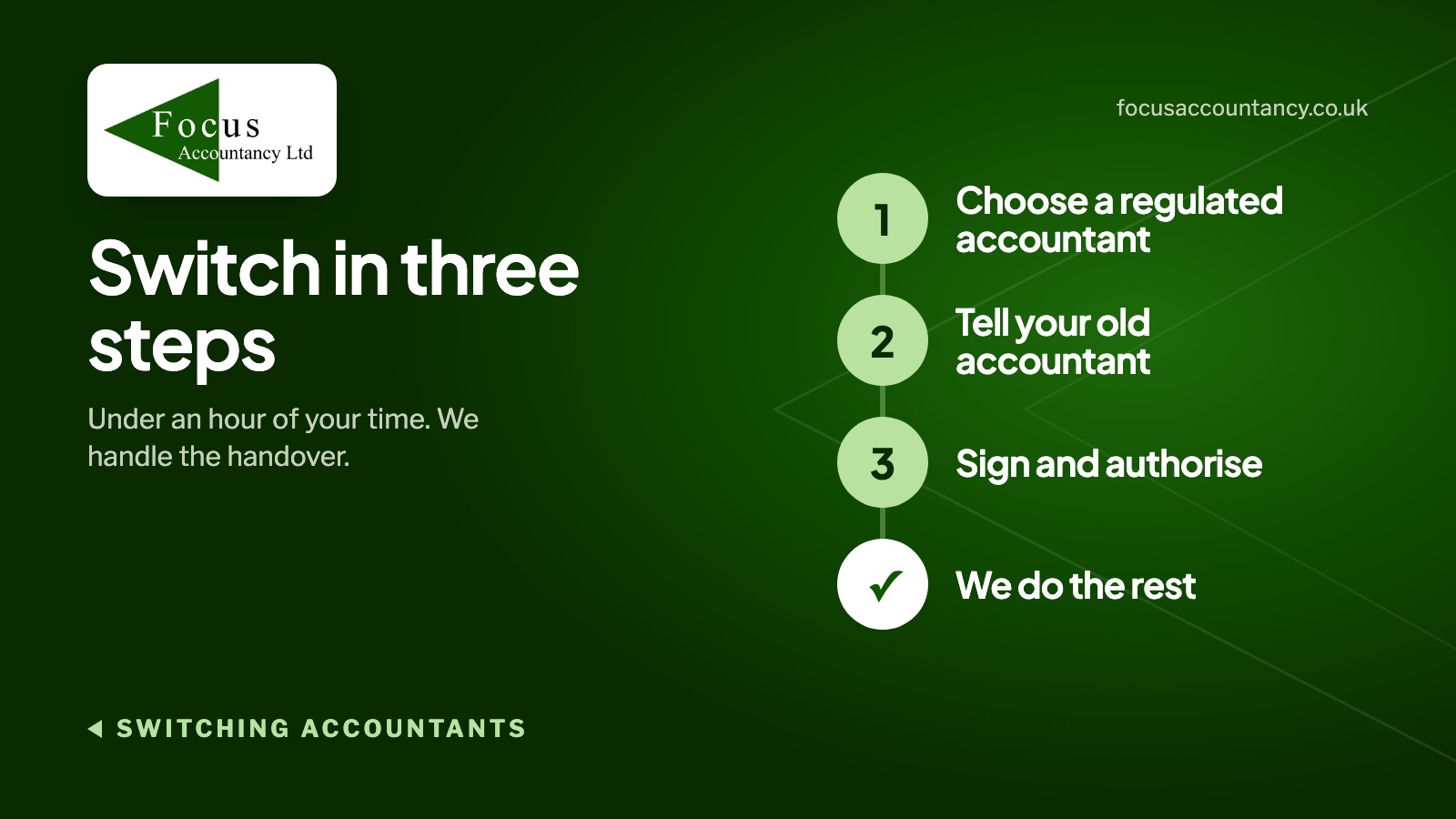
- Choose a regulated accountantCheck their professional body and contractor experience
- Tell your old accountantA short email is enough. No reason needed
- Sign and authoriseEngagement letter, then authorise us with HMRC
- We handle the restClearance letter, handover documents, FreeAgent access
Under an hour of your time. Most handovers complete in two to four weeks.
That is it. Most contractors spend less than an hour on the administrative side of switching. The rest is handled between the two firms. You do not need to transfer files manually, contact HMRC yourself, or do anything at Companies House. Your new accountant manages all of it.
If you have been putting off switching because it felt complicated, the reality is that the friction is almost entirely in your head. The process is designed to be clean, and a good accountant will make it feel effortless. If you are ready to make the move, explore our contractor accounting packages and book a free, no-obligation 30-minute meeting to get a personalised quote.
Frequently Asked Questions
Do I need to tell HMRC I have changed accountants?
You do not need to contact HMRC directly. When you authorise your new accountant with HMRC (online, or on form 64-8 where needed), this gives them authority to act on your behalf and replaces the previous authorisation held by your old firm. Your new accountant sets this up and handles the update. HMRC does not require a separate notification from you as the client.
What records does my new accountant need from my old one?
Your new accountant will typically request your last two years of company accounts, your most recent corporation tax return and any outstanding correspondence with HMRC, your current VAT registration details if applicable, your PAYE scheme reference, and any working papers relevant to the current accounting period. Most of this is transferred via the professional clearance process. You may also be asked to share access to your FreeAgent account or provide bank statements for the current year if the handover is mid-period.
How long does it take to switch accountants?
From the point of notifying your old accountant to having your new accountant fully set up and authorised, the process typically takes two to four weeks. The main variable is how quickly the outgoing firm responds to the professional clearance letter. If they respond promptly, the handover can be complete in under two weeks. If there are delays, your new accountant can begin working from the records you already hold while the formal clearance is finalised.