

Contractor Take-Home Pay: 5 Variables Calculators Get Wrong
Online calculators overstate contractor take-home pay. Here are the 5 real variables, IR35, dividends, pension, billable weeks, and the £100K trap.

16 November 2026 · 9 min read
- 44 weeksA realistic billable year to budget on
- £20,000Gross gap between 52 and 44 weeks at £500 a day
- 60%Effective rate between £100,000 and £125,140
That take-home pay calculator just told you £85,000 a year, but it almost certainly isn't right. If you've plugged your day rate into one of those tools and then wondered why your bank balance tells a completely different story at the end of the year, you're not imagining things.
Those calculators make assumptions that rarely match reality. They assume you're billing every week of the year, that IR35 is a simple on/off switch, and that you have no other income complicating your tax position.
In this article, we'll show you exactly what those tools miss, walk you through the five real variables that determine your actual net pay as a limited company contractor, and give you a framework for working out an honest take-home figure for 2026/27. You'll learn how IR35 status mechanically changes your net pay, how to structure your salary and dividends efficiently, and why pension contributions are one of the most powerful levers most contractors never use.
If you'd rather skip the guesswork entirely, our Ltd Premium and Ltd Tax Boost monthly accounting packages for contractors include salary and dividend planning.
Five variables
The five things that decide what you actually take home
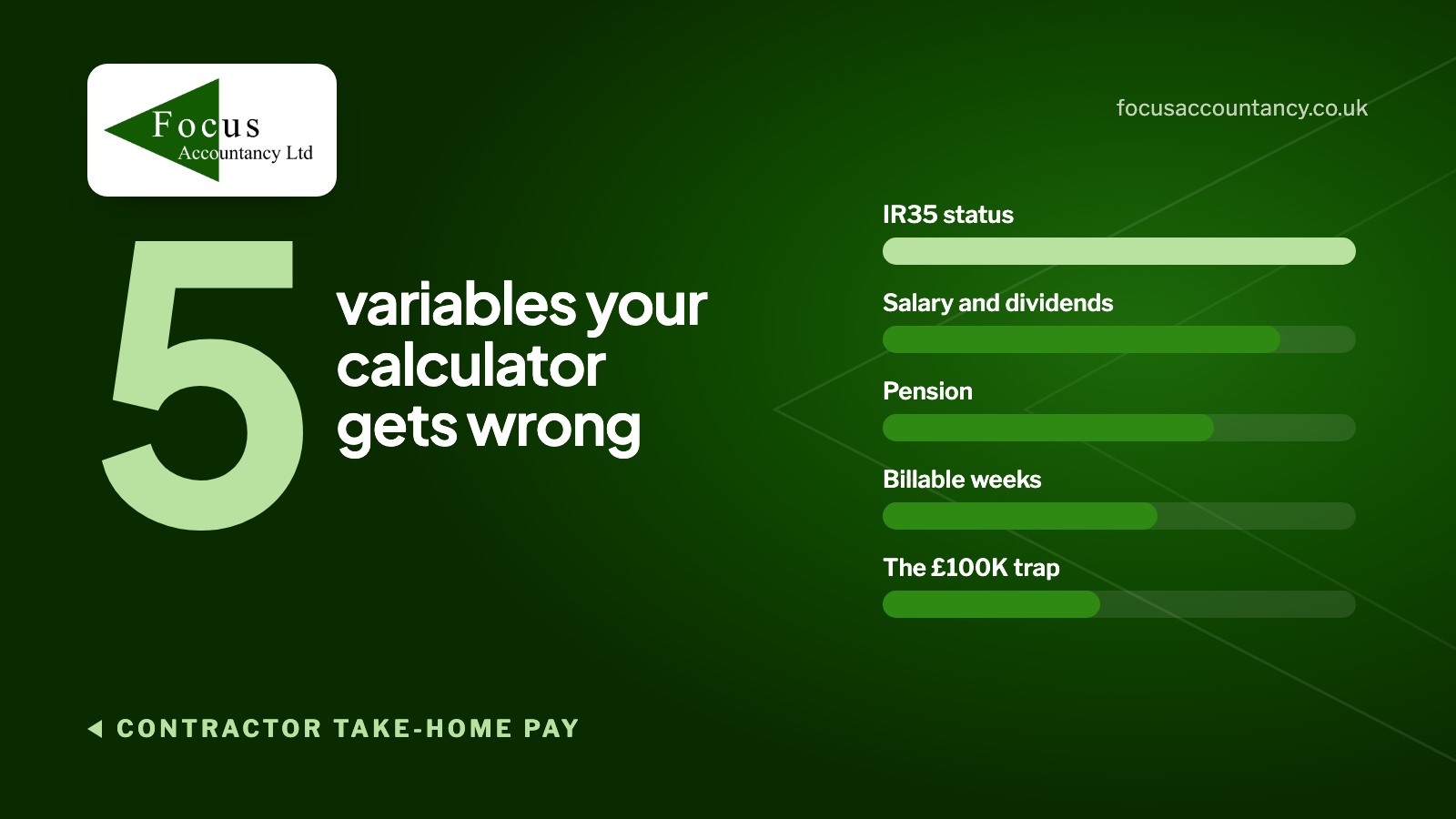
- IR35 statusThe biggest swing factor
- Salary and dividend splitYour main planning tool
- Pension contributionsThe lever most people overlook
- Billable weeksCalculators assume 52
- Other incomeAnd the £100K trap
Variable 1: IR35 status, the single biggest swing factor in your net pay
IR35 is the off-payroll working legislation that HMRC uses to determine whether a contractor is genuinely self-employed or effectively a disguised employee. If you're caught inside IR35, the financial consequences are significant, and most calculators simply show you two numbers without explaining why they're different.
Here's the mechanism. When you're outside IR35, your limited company (technically a Personal Service Company, or PSC) receives the contract fee, pays you a small salary, and distributes the remaining profit as dividends. Dividends are taxed at lower rates than salary and don't attract National Insurance Contributions. That combination is what makes contracting through a limited company tax-efficient.
Inside IR35, where your client is a medium or large business or in the public sector, the fee-payer (your client or their agency) must treat your income as a deemed salary. With a small private-sector client, your own company makes that call and handles the tax. On a £500/day contract, the difference between inside and outside IR35 can run to thousands of pounds a year in net pay, depending on how the fee-payer handles employer National Insurance. That's not a rounding error.
For a deeper look at how to assess your own status, our article on IR35 tips for contractors covers the key indicators HMRC looks at. And if you work in the private sector, it's worth understanding how IR35 affects private sector contractors specifically, since the rules shifted significantly when off-payroll working was extended beyond the public sector.
Does IR35 significantly reduce contractor take-home pay?
Yes, materially. A contractor on £500/day outside IR35 operating through a limited company might realistically take home £65,000 to £70,000 after tax and NICs in 2026/27. The same contractor inside IR35, with income taxed as salary and employer NICs often priced into the day rate, takes home less on the same gross contract. The gap is real, and it's why IR35 status is the first thing we look at with any new contractor client.
Variable 2: Your salary and dividend split for 2026/27
For contractors operating outside IR35 through a limited company, the salary and dividend split is the primary tax planning tool. The principle is simple: pay yourself a salary up to the Personal Allowance, then take the remaining profit as dividends, which are taxed at 10.75% in the basic rate band rather than 20% income tax plus NICs.
Getting this split right requires knowing your total income for the year, including any other sources. That's where generic calculators fall apart, they don't know about your rental income, your spouse's income, or your savings interest, all of which affect where you sit in the tax bands.
What is the most tax-efficient salary and dividend split for a limited company contractor in 2026/27?
For most contractors in 2026/27, a salary of £12,570 combined with dividends up to the basic rate band limit of £50,270 is the most efficient structure. Above that level, dividends are taxed at 35.75%, so higher-earning contractors need to consider pension contributions and other planning tools to avoid unnecessary tax. The right split depends on your total income picture, which is why a personalised review matters more than a generic calculator output.
Variable 2
The 2026/27 salary and dividend structure
- £12,570SalaryUp to the Personal Allowance
- 10.75%Dividend taxUp to the basic rate band limit of £50,270
- 35.75%Dividend taxAbove £50,270
Variable 3: Pension contributions, the lever most contractors overlook
Employer pension contributions made by your limited company are one of the most tax-efficient moves available to contractors, and they're consistently underused. Here's why they're so powerful: contributions paid directly from the company into your pension are a deductible business expense, reducing your Corporation Tax bill. They also don't count as personal income, so they don't push you into a higher tax band or trigger the £100K income trap.
In practical terms, a £10,000 employer pension contribution from your limited company saves at least 19% Corporation Tax (£1,900), or up to 26.5% (£2,650) where company profits fall between £50,000 and £250,000, and keeps that £10,000 out of your personal income calculation entirely. Compare that to taking the same £10,000 as a dividend, where you'd pay Dividend Tax on top of the Corporation Tax already paid on the profit. The pension route is almost always more efficient for contractors who don't need the cash immediately.
We've written in detail about the benefits of director pension contributions and business pension contributions for limited company directors if you want to go deeper on the mechanics.
Can pension contributions increase a contractor's take-home pay?
Not directly, pension contributions reduce your taxable income rather than increasing your bank balance today. But they increase your effective take-home by reducing the tax you pay on the same gross income. A contractor who contributes £15,000 per year into a pension via their limited company could save £2,850 to £3,975 in Corporation Tax and avoid higher-rate income tax on that amount, meaning more of their total earnings are working for them rather than going to HMRC. Over a contracting career, that difference is substantial.
Variable 4: Billable weeks, the number every calculator gets wrong
Online calculators regularly assume you bill 52 weeks a year. Almost no contractor does. Between contracts, you'll have gaps. You'll take holidays. You might have a week or two where a contract ends before the next one starts. You might take time off for training, illness, or simply because you can.
A realistic billable week count for most contractors is 44 to 46 weeks per year. On a £500/day rate at five days per week, the difference between 52 weeks and 44 weeks is £20,000 in gross contract income before any tax is applied. That's the gap between the calculator's output and your actual bank balance, and it's entirely predictable if you plan for it.
Variable 4
At £500 a day, the weeks you bill change everything
Budgeting on 44 weeks rather than 52 is £20,000 less gross income, before any tax.
How many billable weeks should a contractor budget for each year?
We recommend budgeting for 44 billable weeks as a conservative baseline. That accounts for two weeks of holiday, two weeks of gaps between contracts, and a week or two of non-billable time for admin, training, or onboarding. Higher-earning contractors who work in sectors with longer contracts (such as infrastructure engineering or NHS consulting) may achieve 46 to 48 weeks, but 44 is a safer planning figure. Building your financial model on 52 weeks is how contractors end up underprepared for their tax bill.
Variable 5: Other income and the £100K income trap
This is the variable that catches the most contractors off guard, particularly those who also have rental income, investment income, or a working spouse whose income affects household tax planning.
The £100K income trap is a specific feature of the UK tax system where your Personal Allowance (£12,570 in 2026/27) is withdrawn at a rate of £1 for every £2 of income above £100,000. By the time your income reaches £125,140, your Personal Allowance is gone entirely. The effective marginal tax rate in that £25,140 band is 60%.
Variable 5
The £100K trap: where your Personal Allowance disappears
£1 of allowance lost for every £2 of income above £100,000
Gone entirely by £125,140
For a contractor on £500/day billing 44 weeks, gross contract income is around £110,000. After salary, dividends, and any other income, it's entirely possible to land in this trap without realising it. Our article on tax planning when your income exceeds £100K covers the strategies available, including pension contributions, charitable giving, and restructuring dividend timing.
No online calculator accounts for your rental income, your savings interest, or the fact that you received a dividend from a previous year's retained profit. These are personal variables that require a personal conversation, not a generic tool.
How an accountant gives you a number you can actually plan around
A good accountant doesn't just file your returns, they model your tax position before the year starts, so you know what to expect and can make decisions accordingly. That means looking at your IR35 status, your expected billing pattern, your other income sources, your pension position, and the Corporation Tax picture together, not in isolation.
Our clients on our premium packages get salary and dividend planning included in their monthly package, along with unlimited phone and email support when questions come up mid-year. As Christian, one of our clients, put it: "Helpful, knowledgeable team that make time to provide jargon-free planning and advice." That's exactly what we aim for, no jargon, no surprises, just a clear picture of what you'll actually take home.
Frequently Asked Questions
How much does a contractor take home compared to a permanent employee on the same salary?
A contractor operating outside IR35 through a limited company typically takes home more than a permanent employee on the equivalent gross salary, because the salary/dividend structure reduces National Insurance Contributions significantly. However, the contractor also carries costs the employee doesn't: accountancy fees, professional indemnity insurance, no employer pension contributions, no sick pay, and no paid holiday. When those costs are factored in, the net advantage narrows considerably. A contractor on £500/day might appear to earn £130,000 gross annually, but once tax, business costs and non-billable weeks are counted, the real comparison is with a permanent salary well below that headline figure, depending on the employer's benefits package.
How does the £100K income trap affect contractors?
When your total income exceeds £100,000, HMRC withdraws your Personal Allowance at £1 for every £2 earned above that threshold. This creates an effective marginal tax rate of 60% on income between £100,000 and £125,140, far higher than the headline 40% higher rate. Contractors on day rates of £500 or above who bill 44 or more weeks per year are at real risk of falling into this band, particularly if they also have rental income or investment returns. Employer pension contributions are the most commonly used tool to bring adjusted income below £100,000 and escape the trap. This is one of the most valuable things a specialist contractor accountant can model for you before the tax year ends.