
FreeAgent Without an Accountant: When It's Fine and When It's Not
FreeAgent handles a lot, but not everything. This honest guide tells contractors exactly when they need an accountant alongside it, and when they don't.

16 November 2026 · 10 min read
- £90,000VAT registration threshold
- 60%Effective tax rate between £100,000 and £125,140
- 31 Mar 2026HMRC’s free company tax filing service closed
FreeAgent is genuinely excellent software, and for some contractors, it really is enough on its own. If you're running a limited company and wondering whether FreeAgent makes an accountant redundant, you're asking exactly the right question. Most articles either tell you "you always need an accountant" (convenient, given who's writing them) or give generic small-business advice that ignores the specific pressures of being a limited company director.
This article does neither. We'll give you a clear decision framework based on your actual situation. You'll learn what FreeAgent genuinely handles without any professional input, what it structurally cannot do regardless of how well you know the software, and the specific trigger points that change the answer for contractors and limited company directors.
If you're already using FreeAgent through Mettle or another provider and wondering whether adding an accountant is worth it, read on. And if you want to see how Focus Accountancy includes FreeAgent as part of every package, that's worth a look too.
What FreeAgent actually does, and does well
FreeAgent is not a basic bookkeeping tool. It connects to your bank account, categorises transactions, tracks invoices, calculates VAT, and produces real-time profit and loss reports. For a contractor invoicing a handful of clients each month, it handles the operational side of running a business with very little manual input.
Specifically, FreeAgent does the following well without any accountant involvement:
- Bank reconciliation and transaction categorisation
- Invoice creation, sending, and chasing
- VAT return preparation (including MTD-compliant submissions to HMRC)
- Payroll calculations for a single director salary
- Self Assessment tax return preparation (with some caveats)
- Real-time tax estimates based on your current figures
- Expense tracking and mileage logging
That is a substantial list. For a sole trader with straightforward income and no complex tax position, FreeAgent genuinely covers most of what an accountant would handle on a day-to-day basis. The FreeAgent support documentation is also thorough, which reduces the learning curve considerably.
Does FreeAgent give tax advice or just record transactions?
FreeAgent records, calculates, and reports. It does not advise. The software can tell you your estimated tax liability based on the numbers you've entered, but it cannot tell you whether those numbers are structured in the most tax-efficient way, whether your expenses are correctly categorised under HMRC rules, or whether a different approach would legally reduce what you owe. That distinction matters more than most contractors realise when they first start using the software.
Software vs advice
Where FreeAgent stops and an accountant starts
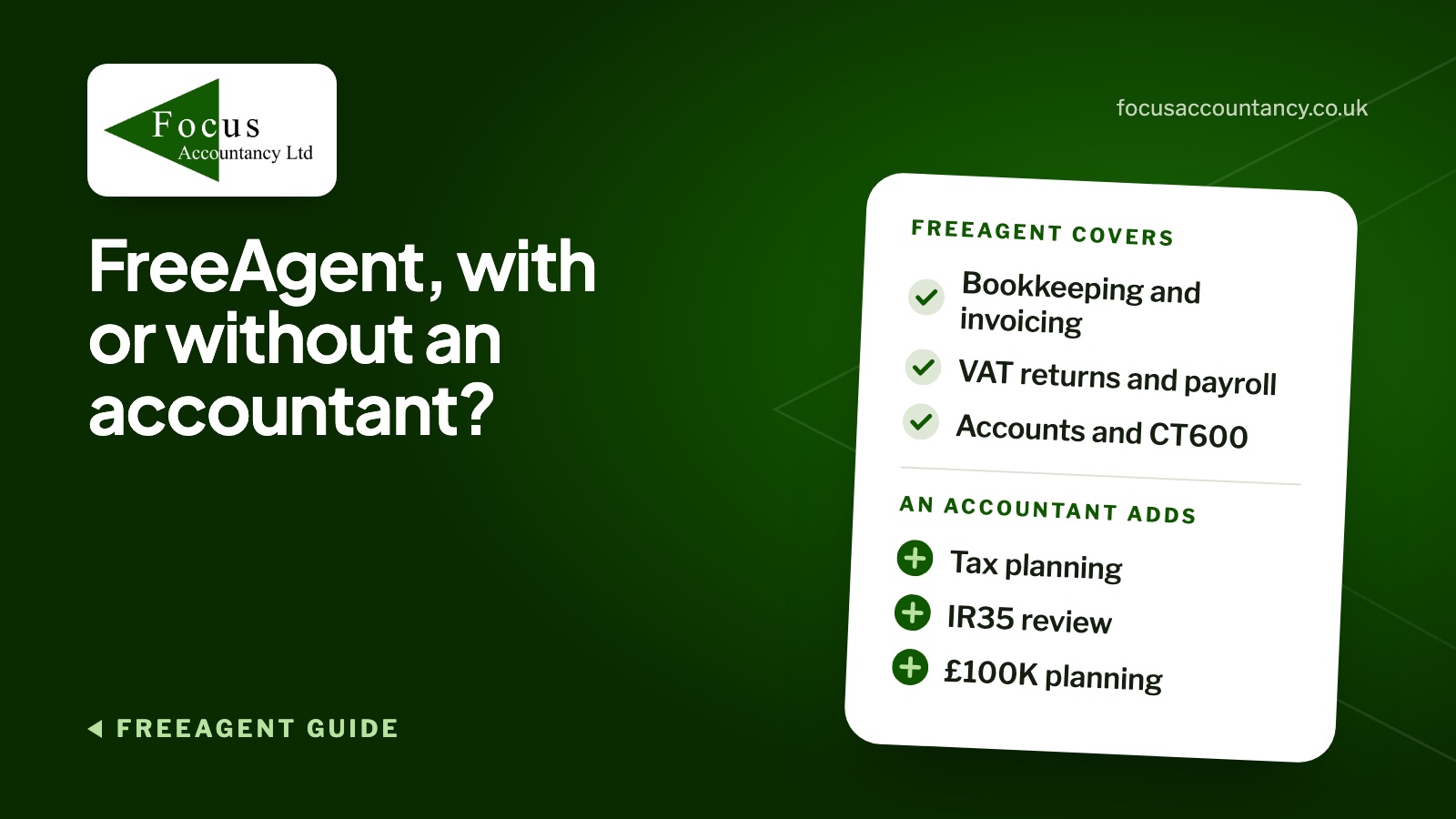
FreeAgent does well
- Bank reconciliation
- Invoicing
- VAT returns
- Payroll
- Accounts, plus Final Accounts and the CT600 for most micro-entity companies
An accountant adds
- Corporation tax planning
- Your salary and dividend split
- IR35 status across your contracts
- Planning before the £100,000 personal allowance taper
- Reliefs and opportunities you didn’t know to claim
The tasks FreeAgent cannot do, no matter how well you know the software
This is where the honest answer gets more nuanced. FreeAgent's limitations are not about complexity of use, they are structural. The software is built to record and report. It is not built to advise, interpret, or plan.
Here are the tasks that fall outside what FreeAgent can do, regardless of your proficiency:
- IR35 status assessment: FreeAgent has no mechanism to assess whether your contracts fall inside or outside IR35. Getting this wrong can result in a tax bill covering the difference between PAYE and contractor tax rates, plus penalties, going back years.
- Salary and dividend split optimisation: FreeAgent can process whatever salary and dividend figures you enter. It cannot tell you the optimal split for your personal tax position, your pension contributions, or your household income situation.
- Corporation tax planning: The software calculates your corporation tax liability. It does not identify legitimate reliefs, timing strategies, or allowable deductions you may be missing.
- Income over £100K planning: Once your income approaches £100K, the personal allowance taper kicks in and the effective marginal rate reaches 60%. FreeAgent will not flag this or suggest strategies to manage it.
- Companies House compliance: Confirmation statements, changes to share structure, and director responsibilities sit outside FreeAgent's scope entirely.
- Capital Gains Tax: If you sell shares, property, or business assets, FreeAgent does not calculate or advise on CGT.
Can I file my own corporation tax return using FreeAgent?
FreeAgent can prepare your accounts and, for most micro-entity companies, file your Final Accounts to Companies House and your CT600 Corporation Tax return straight to HMRC. HMRC's own free filing service closed on 31 March 2026, so software like FreeAgent is now the usual route. More importantly, filing the return is only part of the task, knowing whether the figures are optimised, whether you've claimed all allowable deductions, and whether your accounting date is working in your favour requires professional judgement that the software cannot provide.
When you probably don't need an accountant alongside FreeAgent
We'll be direct here, because most accountancy firms won't be: there are situations where FreeAgent alone is genuinely sufficient.
If you are a sole trader with income below the VAT registration threshold (currently £90,000), a simple expense profile, no employees, and no complex income sources, FreeAgent covers the operational and compliance basics well. You can prepare your Self Assessment return using the software, submit it to HMRC, and manage your bookkeeping without professional help, provided you are confident in what you're doing and you stay on top of your Making Tax Digital obligations as they roll out.
Similarly, if you are in the very early stages of contracting, earning modest income, and your tax position is uncomplicated, the cost of an accountant may not be justified yet. FreeAgent's real-time tax estimates and bank feeds give you enough visibility to stay compliant.
The key word in both scenarios is "uncomplicated." The moment complexity enters the picture, the calculation changes.
When not having an accountant alongside FreeAgent becomes a real risk
FreeAgent showed him accurate figures throughout. It just couldn't tell him the figures were wrong for his situation.
The risks of using FreeAgent without an accountant become real in these scenarios:
- You are a limited company director with income above £50,000 and a salary/dividend structure you set up once and haven't reviewed
- You have contracts that could be assessed as inside IR35 and you haven't had a formal status review
- Your income is approaching or exceeding £100K and you haven't considered pension contributions or other planning strategies
- You have employees, even just one additional person on payroll beyond yourself
- You are VAT-registered and using a scheme (flat rate, cash accounting) that requires active management
- You have rental income, foreign income, or investment income alongside your contracting income
What are the risks of using FreeAgent without an accountant?
The primary risks are not software errors, FreeAgent is reliable. The risks are errors of omission: tax reliefs you didn't know to claim, planning opportunities you didn't know existed, and compliance obligations (particularly around IR35 and Companies House) that the software doesn't monitor. HMRC enquiries triggered by incorrectly categorised expenses or an inconsistent tax position can result in penalties and interest that dwarf the cost of professional advice. The HMRC guidance on penalties makes clear that "reasonable care" is expected of all taxpayers, and "I used software" is not a defence.
The specific trigger points that change the answer for limited company directors
Rather than a vague "it depends," here is a concrete list of trigger points. If any of these apply to you, the case for adding an accountant to your FreeAgent setup becomes compelling.
- Turnover above £50,000: At this level, VAT registration (compulsory once taxable turnover passes £90,000) may be on the horizon, your corporation tax liability is meaningful, and the salary/dividend split decision has real financial consequences.
- IR35 exposure: If you work through a limited company and your contracts could be assessed as disguised employment, you need professional input on IR35 status that FreeAgent cannot provide.
- Income approaching £100K: The personal allowance taper and the 60% effective marginal rate make this a critical planning threshold. We've written specifically about tax planning when your income exceeds £100K because it's one of the most commonly missed issues we see.
- Adding employees or a second director: Auto enrolment obligations, additional payroll complexity, and the implications for your company structure all require professional oversight.
- Selling shares or assets: Capital Gains Tax planning is entirely outside FreeAgent's scope.
- Making Tax Digital deadlines: As MTD for Income Tax rolls out, the compliance requirements become more demanding. Understanding your Making Tax Digital obligations before the deadlines hit is worth doing with professional guidance.
Trigger points
Six signs it’s time for an accountant alongside FreeAgent
- Turnover above £50,000
- Any IR35 exposure
- Income approaching £100,000
- Employees or a second director
- Rental or investment income alongside contracting
- Any Capital Gains Tax transaction
VAT registration becomes compulsory once taxable turnover passes £90,000.
What a FreeAgent-accredited accountant adds that the software never will
Christian, one of our clients at Focus Accountancy, put it well: "Helpful, knowledgeable team that make time to provide jargon-free planning and advice." That phrase, jargon-free planning and advice, captures exactly what software cannot replicate. FreeAgent gives you data. An accountant gives you interpretation, context, and a plan.
A FreeAgent-accredited accountant who works with contractors does several things the software structurally cannot:
- Reviews your salary and dividend split annually against your actual income, pension position, and household tax situation
- Identifies corporation tax reliefs specific to your industry and business structure
- Advises on IR35 risk across your contract portfolio, not just one contract in isolation
- Files your confirmation statement with Companies House and keeps your statutory records current
- Flags changes in tax law that affect your position before they take effect
- Provides a second set of eyes on your FreeAgent data to catch miscategorised expenses before they become an HMRC problem
Another client told us: "I have felt like a valued client and the move to Focus Accountancy was definitely the right one for my business." That kind of relationship, where someone is actively looking out for your tax position, not just processing your numbers, is what distinguishes an accountant from software.
At Focus Accountancy, we include a FreeAgent subscription as part of every package, so you get the software and the professional oversight together. You can see how Focus Accountancy includes FreeAgent as part of every package on our FreeAgent page.
The honest cost-benefit question: what does an accountant cost versus what does a mistake cost?
An HMRC enquiry into a limited company's tax affairs can cost thousands in accountancy fees to resolve, even if the outcome is favourable. A missed IR35 determination can result in a liability covering multiple tax years. An unreviewed salary/dividend split can cost a contractor several thousand pounds annually in avoidable tax. These are not hypothetical risks, they are the situations we regularly help contractors resolve after the fact.
The question is not whether you can use FreeAgent without an accountant. You can. The question is whether the cost of professional advice is justified by the planning value and risk reduction it provides. For most limited company directors earning above £50,000, the answer is yes, and the margin is not close.
If you want a personalised view of whether your current setup is working as efficiently as it should, we offer a free, no-obligation 30-minute meeting to talk through your situation. You can book a free meeting, or find out more about our services and explore our affordable monthly packages for contractors and limited company directors.
Frequently Asked Questions
Is FreeAgent enough for a limited company director?
FreeAgent handles the operational and compliance basics well, bank reconciliation, VAT returns, payroll, and invoicing. But as a limited company director, you have obligations that go beyond bookkeeping: corporation tax planning, Companies House filings, salary and dividend optimisation, and IR35 awareness. FreeAgent does not cover these. Whether it is "enough" depends on the complexity of your tax position, but for most limited company directors earning above £50,000, professional input alongside the software pays for itself.
What does FreeAgent actually do that an accountant would otherwise do?
FreeAgent automates the tasks that used to require manual bookkeeping: categorising transactions, reconciling bank feeds, calculating VAT, running payroll, and preparing draft accounts. It also produces real-time tax estimates and supports Making Tax Digital submissions. These are tasks an accountant would previously have spent billable hours on. What it does not replace is the advisory function: reviewing your structure, identifying planning opportunities, and interpreting tax law in the context of your specific situation.
When should a contractor get an accountant even if they already use FreeAgent?
The clearest trigger points are: turnover above £50,000, any IR35 exposure, income approaching or exceeding £100,000, adding employees or a second director, holding rental or investment income alongside contracting income, and any transaction involving Capital Gains Tax. If any of these apply, the cost of professional advice is almost certainly less than the cost of the planning opportunities you are missing or the compliance risks you are carrying. The Focus Accountancy team works specifically with contractors and limited company directors, so the advice is relevant to your situation rather than generic.
How your salary and dividend split affects take-home pay
The salary and dividend split is one of the most consequential decisions a limited company director makes, and it is one FreeAgent cannot optimise for you. The right split depends on your total income, your pension contributions, your spouse's income if relevant, and the current tax thresholds. Getting it wrong in either direction, too much salary or too little, results in avoidable tax. Understanding how your salary and dividend split affects take-home pay is worth reviewing at least annually with a professional who knows your full picture.